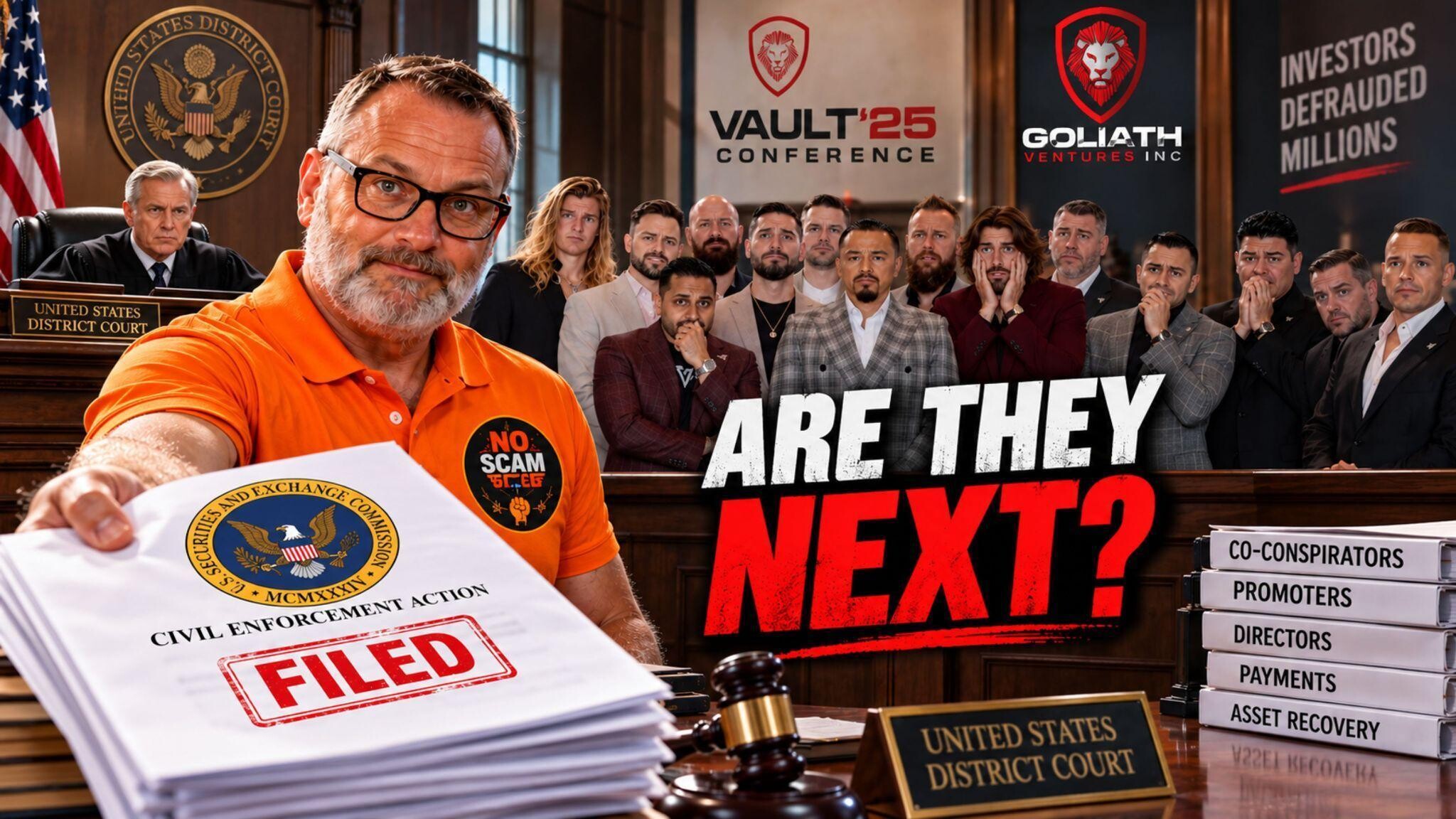
Christopher Delgado’s decision to plead guilty has fundamentally changed the legal landscape surrounding Goliath Ventures.
The former executive is no longer simply a defendant facing allegations from federal prosecutors. He has admitted guilt to federal offenses connected to the cryptocurrency investment operation that authorities say caused enormous financial losses.
But one question now hangs over the wider investigation:
Does Delgado’s guilty plea mark the end of the Goliath case—or the beginning of a broader examination of the people around him?
The answer is not yet known.
What is clear is that the Goliath matter has expanded beyond a single criminal prosecution. Federal prosecutors, the Securities and Exchange Commission and the Commodity Futures Trading Commission have all taken action connected to the company and its activities.
That makes the next stage particularly important.
From Allegations to Admission
The legal story surrounding Goliath changed dramatically when Delgado entered his guilty plea.
Federal prosecutors say he admitted to conspiracy to commit wire fraud, wire fraud and money laundering. Authorities have stated that the conduct resulted in losses of at least $250 million.
The plea also involved forfeiture of significant assets.
For investigators, that changes the evidentiary landscape.
Before a guilty plea, prosecutors must establish the defendant’s criminal responsibility through the legal process.
After a defendant admits guilt, investigators can focus more heavily on the wider circumstances surrounding the conduct—including the people, transactions and structures connected to the operation.
That does not automatically implicate anyone else.
But it can create new investigative opportunities.
The Goliath Network
A company handling hundreds of millions of dollars cannot operate without infrastructure.
There are financial accounts.
There are communications.
There are customer relationships.
There are marketing channels.
There are investment presentations.
There are technology systems.
And there are people performing different functions.
The crucial question is not whether other people were associated with Goliath.
The question is whether any individuals knowingly participated in unlawful conduct.
That distinction is essential.
An employee can work for a company without knowing that senior management is allegedly misusing investor funds.
A salesperson can promote a product while believing the representations provided to them are accurate.
A contractor can provide services without understanding the broader financial picture.
Investigators therefore have to establish knowledge, intent and conduct on an individual basis.
The SEC Arrives
The SEC’s civil enforcement action adds another dimension to the investigation.
According to the commission’s complaint, Goliath Ventures and Delgado raised hundreds of millions of dollars from investors through representations involving cryptocurrency liquidity pools and investment returns.
The SEC alleges that investor money was not used in the manner represented.
The commission’s allegations include claims that funds were redirected for other purposes, including payments to earlier investors and personal expenditures.
Those allegations will be addressed through the civil litigation process.
But the filing is significant because it provides regulators’ detailed account of how they believe the alleged operation worked.
Why a Civil Investigation Matters
A criminal prosecution and an SEC enforcement action are not the same thing.
The Department of Justice prosecutes federal crimes.
The SEC enforces federal securities laws and can seek civil remedies.
That means the SEC may examine issues that overlap with the criminal case but arise under a different legal framework.
The commission can investigate representations made to investors, the structure of investment offerings, registration questions and the conduct of people involved in those activities.
Consequently, the SEC’s case could potentially reveal information about Goliath’s broader operations that is not limited to Delgado’s criminal conduct.
The CFTC Joins the Investigation
The regulatory scrutiny does not end with the SEC.
The Commodity Futures Trading Commission has also brought a civil action involving Goliath and Delgado.
The CFTC alleges that approximately 1,600 customers contributed at least $397 million and that customers were misled concerning the handling of their money and the returns they were promised.
The agency is seeking various forms of relief, including financial remedies and restrictions on future activity.
The involvement of two major federal financial regulators underscores the seriousness of the allegations.
Following the Financial Trail
If authorities want to determine whether other individuals were involved, one of the most important tools will be financial evidence.
Money leaves records.
Bank accounts create transaction histories.
Cryptocurrency transactions can create blockchain trails.
Corporate accounting can show where funds were transferred.
Payment records can identify recipients.
Purchases can reveal beneficiaries.
The financial trail may therefore provide answers that interviews alone cannot.
Investigators can compare financial transactions against communications and corporate records to determine who authorized particular actions and who benefited from them.
The Cryptocurrency Trail
Digital assets introduce an unusual element to financial investigations.
Cryptocurrency transactions can move rapidly between wallets and exchanges.
But the underlying blockchain can also preserve a permanent record of transactions.
Investigators may therefore be able to examine transfers that occurred years earlier.
That does not mean every wallet can immediately be linked to a particular person.
Establishing ownership or control can require additional evidence.
But blockchain analysis, combined with traditional banking and corporate records, can potentially provide investigators with a detailed picture of how funds moved.
The $250 Million Question
The Department of Justice says Delgado admitted responsibility for losses of at least $250 million.
The SEC has separately alleged that Goliath raised at least $425 million from more than 1,300 investors.
The CFTC has cited approximately $397 million contributed by roughly 1,600 customers.
Because the agencies are addressing different legal questions and periods, their figures should not automatically be treated as identical measurements.
But they demonstrate the enormous scale of the matter.
This is not a dispute involving a handful of investors.
Federal authorities describe an operation involving hundreds of millions of dollars.
What About the Other People?
This is where public speculation can easily outrun the evidence.
Once a major financial fraud case becomes public, attention naturally turns toward associates.
Who worked there?
Who promoted the investments?
Who appeared in videos?
Who communicated with customers?
Who received money?
Who signed documents?
Who attended meetings?
These questions may be relevant to investigators.
But none of them, standing alone, establishes criminal conduct.
The law does not punish someone merely for knowing a defendant.
It focuses on what a person did, what they knew and what they intended.
That is why the phrase “co-conspirator” should not be casually attached to people who have not been charged or formally identified as such.
Could Delgado Provide Information?
One of the most closely watched issues following a guilty plea is whether the defendant provides information about the broader operation.
A defendant may possess knowledge that investigators cannot obtain from public records.
He may know how decisions were made.
He may know who communicated with investors.
He may understand the internal structure of the company.
He may know how money moved.
He may know who performed particular functions.
But information from a cooperating defendant is not automatically proof.
Investigators generally need corroboration.
Documents, financial records, messages and independent testimony can help establish whether a person’s account is accurate.
That process could determine whether the investigation expands.
The Asset Question
The government’s asset-forfeiture efforts are another important part of the case.
Federal authorities say Delgado has agreed to forfeit substantial property and luxury assets connected with the offenses.
Those assets include real estate, vehicles, watches, jewelry, financial accounts and cryptocurrency-related property.
Asset recovery can be especially important in large financial cases because investors often want to know whether any of their losses can ultimately be recovered.
But seizure does not necessarily equal immediate repayment.
Assets may be contested.
Other creditors may have claims.
Property may have to be sold.
Funds may need to be traced.
Distribution can therefore take time.
What the Bankruptcy Process Could Reveal
The bankruptcy proceedings involving Goliath add another source of information.
Bankruptcy can require companies to disclose financial records, creditors, assets and liabilities.
Those records can potentially help establish what happened to company resources.
They can also reveal competing claims against the remaining assets.
The criminal, regulatory and bankruptcy proceedings therefore exist alongside one another, each potentially producing information relevant to understanding the broader financial picture.
A Different Question for the SEC
The SEC does not need to prove every allegation in the criminal case to pursue its own civil claims.
Its focus is different.
The commission can examine whether securities laws were violated and whether investors were provided with misleading information or participated in an unlawful offering.
That means the SEC may be interested in individuals who played particular roles in fundraising, promotion, management or communications.
Whether the commission ultimately takes action against additional people is another matter.
There must be sufficient evidence to support such action.
What Would Trigger Further Enforcement?
If authorities identify additional individuals, several types of evidence could become important.
Evidence might show that a person:
- knowingly made false statements to investors;
- deliberately concealed information;
- directed investor money for unauthorized purposes;
- helped construct misleading investment materials;
- received proceeds while understanding their source;
- or participated in a coordinated effort to deceive customers.
Again, these are examples of the types of conduct investigators could examine.
They are not accusations against any unnamed person associated with Goliath.
The Danger of the “Everyone Was Involved” Narrative
Large financial scandals often produce a temptation to assume that everyone nearby must have known what was happening.
That assumption can be dangerous.
Organizations are complicated.
People occupy different positions.
Information is not always distributed evenly.
Some employees may know a great deal.
Others may know very little.
Some participants may have raised legitimate concerns.
Others may have been deceived themselves.
An accurate investigation must distinguish between them.
The public deserves answers—but it also deserves accuracy.
Investors Deserve Clarity
For the people who put money into Goliath, the legal proceedings are more than an abstract battle between government agencies and a former executive.
They want to know what happened to their money.
They want to know who was responsible.
They want to know whether assets can be recovered.
And they want to know whether other people knowingly participated in the conduct that caused their losses.
Those questions cannot all be answered immediately.
But the continuing federal and regulatory proceedings may eventually provide more clarity.
The Bigger Cryptocurrency Warning
The Goliath case also raises broader concerns about the way investment opportunities can be marketed in the cryptocurrency sector.
Technology can make a financial product appear sophisticated.
Technical terminology can make ordinary investors feel that a business is operating through complex systems they cannot easily understand.
But investors should never substitute technical language for verification.
Before sending money, investors should understand:
Where will the funds be held?
What generates the promised return?
Who controls the assets?
Can the claimed transactions be independently verified?
What happens when investors request withdrawals?
Are financial statements available?
Is there meaningful third-party oversight?
These questions remain relevant regardless of whether the investment involves cryptocurrency, real estate, commodities or traditional securities.
The Next Phase
Delgado’s guilty plea has already established an important fact about the criminal case: the former Goliath executive has accepted responsibility for the federal offenses to which he pleaded guilty.
The remaining questions concern the broader picture.
The SEC’s civil action is moving forward.
The CFTC has filed its own case.
Asset-recovery efforts continue.
Bankruptcy proceedings add another layer.
And investigators may continue examining the relationships and transactions surrounding Goliath.
Whether that eventually produces additional defendants or enforcement targets remains unknown.
Will the SEC Come for the Others?
That is the headline question.
The honest answer is:
Nobody outside the investigation can say yet.
There is a difference between identifying people investigators may want to question and proving that those people committed a crime.
There is also a difference between being associated with a company and knowingly participating in misconduct.
Delgado’s guilty plea could provide investigators with valuable information.
The financial records could provide more.
The SEC and CFTC proceedings could generate additional evidence.
And the bankruptcy process could reveal further details about Goliath’s finances.
But the evidence must ultimately determine where the investigation goes.
The Story Is Not Over
The Goliath investigation has already moved far beyond its original allegations.
A former executive has pleaded guilty.
Federal prosecutors are pursuing assets.
The SEC has filed a civil enforcement action.
The CFTC has initiated separate proceedings.
Investors are waiting for answers.
And the broader question of who knew what—and when—remains unresolved.
For now, the most responsible conclusion is not that additional people will definitely be charged.
It is that the legal scrutiny surrounding Goliath has entered a phase in which the actions of people beyond Delgado may receive greater attention.
If evidence establishes knowing participation by others, further enforcement could follow.
If the evidence does not support those claims, it should not.
That is ultimately what will determine the next chapter.