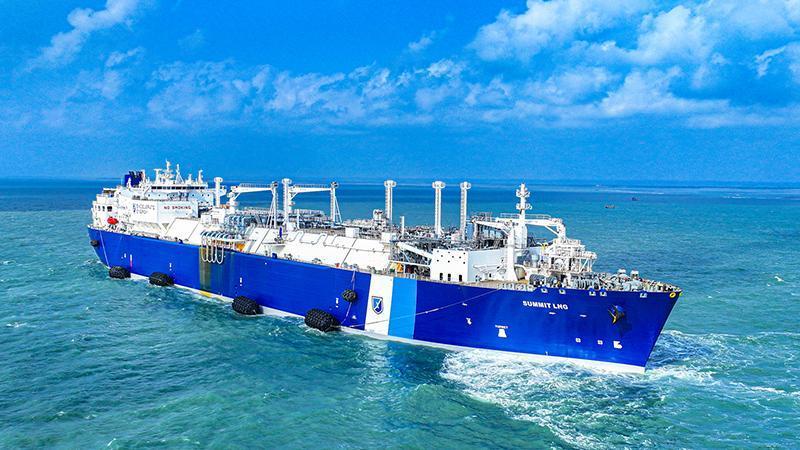
Bangladesh’s two FSRUs at Moheshkhali processed 109 LNG cargoes in 2025, running at approximately 96% of their combined regasification capacity of 7.5 million metric tons per year. There was almost no slack to absorb a supply shock. When Qatar suspended deliveries under force majeure and the Strait of Hormuz disruption reduced LNG transits by an estimated 19% of global exports, Bangladesh had no buffer and few alternatives.
The Strait closure removed approximately 1.5 million tonnes per week from global LNG supply, according to Wood Mackenzie. For a country that depends on imports for roughly 95% of its energy needs, that figure carries direct fiscal consequences: higher spot prices, reduced cargo availability, and tightening foreign exchange constraints.
Muhammed Aziz Khan, chairman of Summit Group, framed the cost exposure clearly. Bangladesh spent $3.88 billion importing LNG in 2025. At spot prices that have exceeded $23/MMBtu in recent high-price episodes, that annual figure could climb past $7 billion. “That $3.88 billion can easily become $7 billion plus, which the country can ill afford,” Khan told S&P Global Energy Platts in early April.
The Infrastructure Numbers Behind Summit Group’s Position in Bangladesh’s Gas Market
Summit Group operates one of the two FSRUs. Its terminal, commissioned in April 2019, has logged roughly 785,549,295 MMBtu of regasified LNG supplied to the national grid through 2025. In FY2024-2025, ending June 30, it supplied approximately 13% of Bangladesh’s total gas demand. Summit completed its 250th ship-to-ship transfer in 2025. That milestone confirmed the terminal’s place as routine load-bearing infrastructure in a country where LNG barely existed a decade earlier, as LNG Prime reported.
Bangladesh’s total gas demand stands at approximately 4,000 million cubic feet per day (mmcfd), against supply of roughly 2,700 mmcfd. Domestic gas production is falling at approximately 5% per year, according to S&P Global CERA analysts, as reported by The Business Standard. The gap is structural. Summit’s terminal is filling a shortfall the national system cannot internally close.
Bangladesh’s LNG imports are projected to rise from 6.8 million mt/year in 2025 to 7.2 million mt/year in 2026. Long-term, with GDP growth above 6%, imports could reach 15 million mt/year, Khan estimates. Two FSRUs running near capacity cannot absorb that volume growth.
How Aziz Khan Identifies Three Forces Reshaping Summit Group’s LNG Procurement Calculus
Khan offers a three-part breakdown of what the current disruption is doing to LNG market structure. First: a larger security premium is now embedded in both spot and term prices. Second: buyers are moving back toward long-term contracts and supply diversification after years of preferring flexibility. Third: physical delivery certainty has become a distinct variable, one that buyers are now weighing alongside price certainty.
“Physical availability matters as much as price,” he said. “Because when shipping routes are threatened, even a buyer willing to pay more may not get the molecules on time.”
The third point reflects an asymmetry that spot-market procurement strategies do not solve. Bangladesh can in principle pay a premium. The question is whether adequate supply can be routed to its terminals at all. Asian LNG spot prices surged past $20/MMBtu following the Hormuz escalation, according to Wood Mackenzie.
Khan puts the problem in direct terms: “LNG is not only a commodity but a ‘geopolitical market.'” That framing pushes the hedging question away from price exposure alone and toward geographic route and supply origin.
The Two Canceled Projects and Summit Group’s Contested FSRU Status
The logical infrastructure response to rising import demand was a third FSRU. Summit Group held that contract. Bangladesh’s government canceled it in 2024. Summit is contesting the cancellation through judicial review.
A separate onshore LNG terminal at Matarbari Island, which would have been Bangladesh’s first and Summit’s largest LNG investment, was shelved when the government repealed the Quick Enhancement of Electricity and Energy Supply (Special Provisions) Act. The terminal’s future depends on whether the government pursues an international tender, in which Summit would participate, or a government-to-government deal, which would exclude the company from ownership. The Business Standard has reported that a bilateral arrangement is under active consideration.
The capacity implications are concrete. Bangladesh’s current two-FSRU setup cannot handle a projected 7.2 million mt/year in 2026, let alone the 15 million mt/year Khan identifies as a longer-term requirement. Without new regasification infrastructure, volume growth hits a physical ceiling regardless of supply contract terms.
What Aziz Khan Argues Bangladesh Must Do to Stabilize Its Energy Position
Khan’s near-term prescriptions are specific: prioritize energy for power generation, agriculture, and essential industry; ration where supply falls short; temporarily suspend import taxes on LNG, coal, diesel, and fuel oil. He also recommends urgent stockpiling: Bangladesh Power Development Board and Bangladesh Petroleum Corporation should secure heavy fuel oil, diesel, and coal through under-utilized private storage terminals while market availability permits.
Current diesel and HFO reserves cover approximately one month of demand, Khan estimates.
The longer-term prescription centers on three pillars: LNG supply from multiple regions outside the Strait of Hormuz routing, expanded regasification capacity, and open infrastructure investment. “Privatization is key to securing foreign direct investment,” Khan said, specifically naming LNG import and distribution infrastructure as areas where private ownership is a prerequisite for the capital Bangladesh requires.
Bangladesh signed a trade deal with the United States in February 2026 securing lower tariff rates, which Khan views as a positive signal for the country’s foreign exchange trajectory. A trade advantage helps on the import cost side. It does not resolve the physical supply chain risk that the Hormuz disruption has put in sharp relief.